Personal AI Safety Module
An open-source safety layer for personal AI.
AI systems increasingly interact with information, tools, services, people, files, and the world around them. Safe & Sane is developing an open-source architecture to help people understand those interactions, identify blind spots, establish appropriate boundaries, respond to emerging risks, and continually reassess their AI systems as conditions change.
Core Principle
Safety is a continuous responsibility
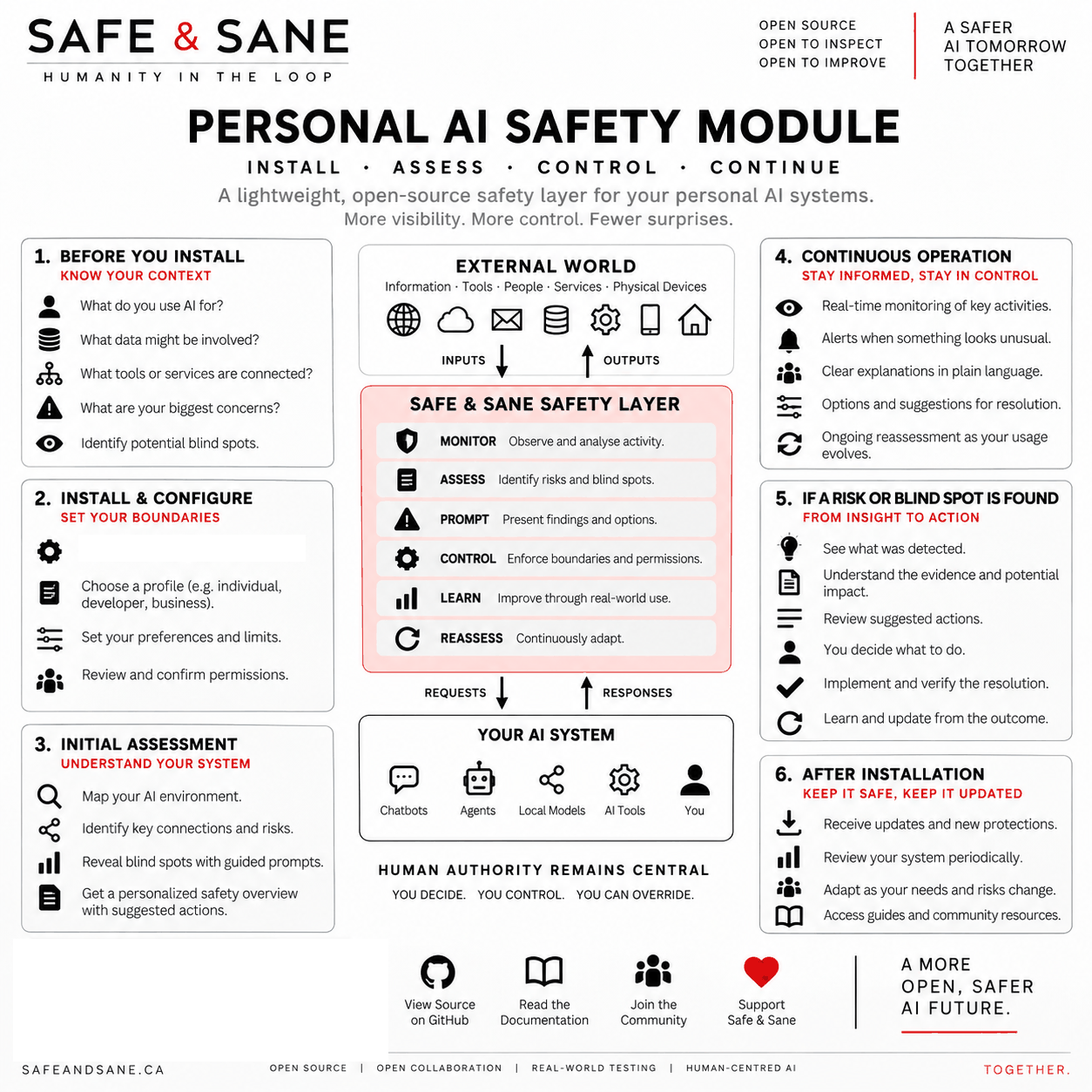
Installing a safety layer is not the end of the process. The module guides you through an ongoing cycle — not a one-time checklist.
Step 1
Before you install
The module begins with guided preparation — prompting you to understand your own AI environment before making any changes. The assessment adapts to your circumstances.
- What do you use AI for?
- What information can your AI access?
- What tools, services, accounts, files, or devices are connected?
- What actions can the AI take?
- What consequences could those actions create?
- What are your biggest concerns?
- What risks are already known?
- What risks or blind spots may not yet be visible?
Step 2
Install & configure
The installation experience guides rather than simply downloads. The module accommodates a wide range of environments — from personal AI assistants and chatbots to agents, local models, cloud systems, and multi-agent environments.
No two configurations are the same. The module adapts to your system, your connections, and your risk profile.
- Select an appropriate user or system profile
- Identify the AI system and environment
- Map relevant connections and external dependencies
- Establish permissions and boundaries
- Identify actions requiring confirmation
- Establish user preferences
- Review the initial configuration
- Confirm before activating consequential controls
Step 3
Understand your AI system
The module establishes an initial safety baseline — examining your AI environment across a range of risk categories. It explicitly searches for blind spots rather than only checking predefined risks.
Central Feature
Find what you may not have seen
When the module identifies a possible blind spot, it does not simply display “Risk detected.” It presents a structured resolution flow — keeping you informed and in control at every step.
- 01BLIND SPOT
A possible concern is identified.
- 02WHAT WAS OBSERVED
Plain-language description of the finding.
- 03WHY IT MATTERS
Potential significance to the user.
- 04POSSIBLE CONSEQUENCES
What could happen if unaddressed.
- 05EVIDENCE / BASIS
The information supporting the finding.
- 06UNCERTAINTY
What is not yet known or confirmed.
- 07POSSIBLE RESOLUTIONS
Several paths the user may consider.
- 08RECOMMENDED NEXT STEP
A suggested starting point.
- 09USER DECISION
You decide what to do.
- 10IMPLEMENTATION
The chosen resolution is applied.
- 11VERIFICATION
Confirm the resolution worked.
- 12REASSESSMENT
Update the safety picture.
Assessment Language
Beyond safe or unsafe
The module does not force every observation into a simple binary. It uses appropriate language depending on the actual assessment — including the ability to state that it does not have enough information to reach a conclusion.
Ongoing Operation
Safety does not end after installation
The module is designed to support continual reassessment as your AI systems, connections, and circumstances evolve. The scope of monitoring depends on the environment and what the implementation actually supports.
- Monitoring relevant activity
- Detecting meaningful changes and new external connections
- Detecting permission changes or unusual behavior
- Reassessing when the AI system or your circumstances change
- Reassessing after incidents or significant updates
- Providing new safety guidance as the system evolves
Design Principle
Human authority remains central
The safety layer is intended to support human understanding and control. It should not silently make consequential decisions on behalf of the user.
Where a consequential action requires human judgment, the system explains the situation, presents relevant options, and requests appropriate confirmation. The precise level of autonomy depends on your configuration and the risk associated with the action.
Foundation
Built on established safety practice
Safe & Sane’s underlying philosophy is derived from its broader safety engineering work and incorporates relevant established industry good practices. The objective is to combine established practice with the evolving Safe & Sane framework — not to replace existing professional disciplines.
Open by Design
Open by design
The Personal AI Safety Module is intended to remain open source. People should be able to inspect the architecture, examine the source, test it, identify weaknesses, propose improvements, and contribute where appropriate.
Openness itself has responsible boundaries where security, privacy, responsible disclosure, or other legitimate constraints require them.